








There's something we should have done a long time ago: explain, once and for all, the difference between microgreens, shoots, sprouts, and baby leaves.
We understand the confusion. For those of us who work with these products every day, the differences seem obvious. For anyone looking and seeing "just tiny plants", not so much. And the truth is, even within the industry, some people lump everything together in the same bag.
Well, it's not all the same thing.
They are different products, grown differently, harvested at different times, and often used differently. So let's clear things up once and for all.
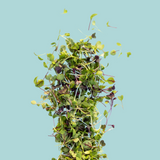
Microgreens. These are probably the best known around here: young plants, grown from a seed and harvested after developing their first true leaves (the exact moment varies from species to species). So we're no longer talking about a germinating seed. There is already a tiny plant, with a stem, leaves, and its own identity.
And here's one of the most interesting things: despite their size, they already carry a lot of the adult plant inside them. The flavour can be intense, concentrated, sometimes surprisingly different from what you'd expect from something so small. That's why micro coriander tastes like coriander, micro basil tastes like basil, and a micro radish can pack a punch that leaves very little room for doubt.
Shoots. Here we're talking about something else entirely. A shoot is a plant that has started to develop from the seed, often eaten with the seed itself, typically featuring a tiny root, stem, and very young structures. Mung bean, pea, or alfalfa immediately come to mind, but there are many other examples.
Sprouts. These are even smaller, representing a much earlier stage in the plant's development. The seed has just begun to germinate, and that's precisely the moment it's eaten. There are no developed leaves yet. It's simply the moment the seed starts waking up.
And this is where a big part of the confusion comes from:
A sprout isn't a tiny microgreen. A microgreen isn't a sprout that grew bigger. They are different stages in the same plant's life, and therefore, completely different products.
Baby leaves. Perhaps easier to recognise, because they are exactly what the name suggests: young leaves. We're closer to what we usually picture when we think of a plant to eat. The leaves are larger, the plant has had more time to grow, and the product is designed to be used as a leaf—in salads, garnishes, and other dishes.
If we want to simplify it, it's a bit of a journey: the seed starts to germinate, we have a sprout. The plant keeps developing, we have a shoot. The first true leaves appear, and we enter microgreen territory. Let it grow a little more, and we reach baby leaves.
Nature, of course, doesn't work with a ruler and a stopwatch, and there are differences between species and production methods. But this is a good way to understand the basics.
And the essential takeaway is this: size is not what defines each of these products. It's probably the biggest confusion of all.
A microgreen isn't an adult vegetable chopped small. A baby leaf isn't a microgreen that we let grow too big. A sprout isn't an even smaller version of a microgreen.
What sets them apart is the stage of the plant's life in which they are harvested and consumed. It sounds like a small difference. It isn't. It changes the texture, changes the flavour, changes the appearance, changes how they keep, and above all, changes how they can be used in your kitchen.
And that's perhaps what makes this family of products so interesting: we're always talking about the same thing—a plant—at different moments in its life. It's like comparing a newly sprouted herb to that same plant when fully grown. The genetics might be identical, but what ends up on your plate can be completely different.
So next time someone says "that's all just sprouts", you can answer "No. It isn't."
And now you know why.
We took a little while to explain it, but better late than never. :)